
Legal Loophole Plus Politics: Foreign Workers and Employers Face Uncertainty
Status as of 28.10.2026: On WorkinRomania.gov.ro, employer registration, employer authorization, and single applications for D/AM2 visas remain deactivated. On 26.10.2026, the Ministry of Labor opened public consultation on new rules for the List of Deficit Occupations, with observations due by 30.10.2026. On 28.10.2026, the AUR president requested a parliamentary inquiry committee in Parliament regarding workers from outside the EU.
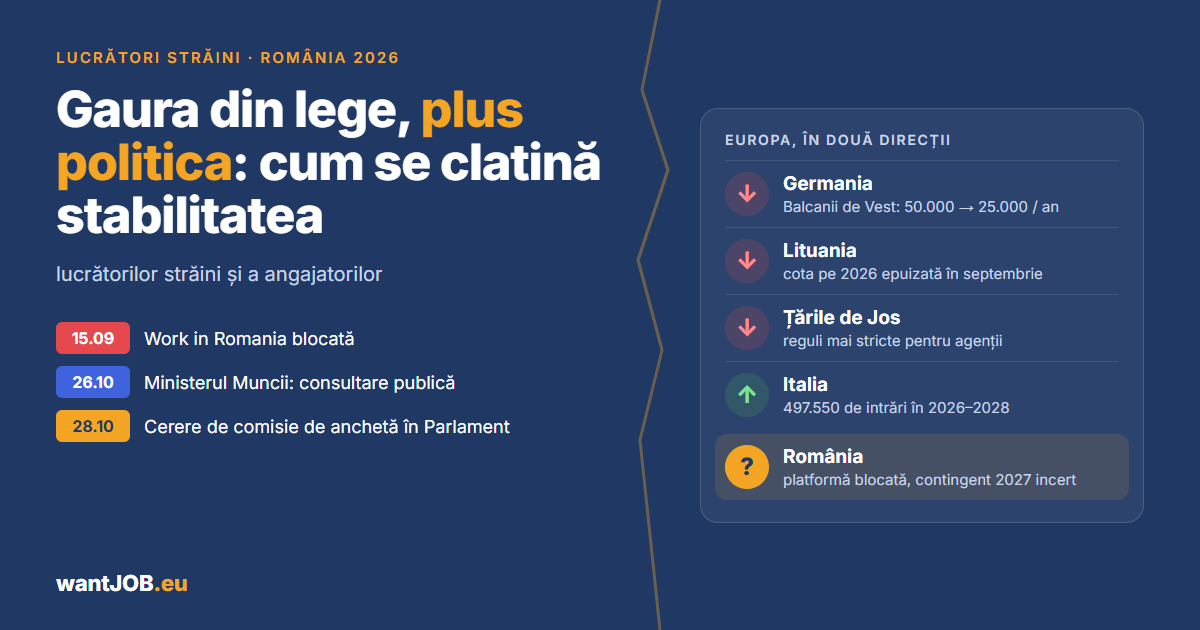
Stability for foreign workers and employers who hire them is now shaken from two sides: a legal loophole that has kept the WorkinRomania platform blocked since 15 September, and political pressure that questions the 2027 quota. The Ministry of Labor took the first concrete step toward unblocking on 26 October. Two days later, AUR requested a parliamentary inquiry committee. Around Romania, Europe is moving in two directions: Germany, Lithuania, and the Netherlands are tightening rules, while Italy is increasing quotas. This article explains what happened, what was said, what the data shows, and what each party can do.
In Brief
| Question | Answer |
|---|---|
| What is the "legal loophole"? | OUG 32/2026 (Emergency Ordinance 32/2026) ties hiring via the D/AM2 route to the List of Deficit Occupations. The order approving the list was suspended in court, and the platform halted workflows on 15.09.2026 |
| What did AUR request? | On 28.10.2026, George Simion requested a parliamentary inquiry committee regarding workers from outside the EU. The committee exists only if voted in the Chamber plenary |
| Does anything legal change now? | No. Statements and the inquiry request do not modify the law. Valid residence permits remain valid |
| What is the Ministry of Labor doing? | It proposes thresholds of 5 instead of 10 for including an occupation on the list and a 10-day response to employer proposals. Observations due by 30.10.2026 |
| What is the rest of Europe doing? | Germany is halving the quota for the Western Balkans from 2027, Lithuania exhausted its 2026 quota, the Netherlands is tightening rules, Italy is bringing in 497,550 workers in 2026–2028 |
| What can employers do? | Submit observations by 30.10.2026, prepare files for reopening, and plan 2027 recruitment with extra lead time |
The Legal Loophole
OUG 32/2026 replaced the labor market test conducted for each position with a ministry-set list of occupations. The D/AM2 route works only for occupations on the List of Deficit Occupations. When the list was suspended, the law remained in force, but without the piece it relies on.
| Date | What Happened |
|---|---|
| 02.12.2026 | Deadline in main case file 5258/2/2026; suspension of the order holds until the ruling on the merits |
| 28.10.2026 | WorkinRomania workflows remain deactivated |
| 26.10.2026 | Ministry of Labor opens public consultation on changing the list methodology |
| September 2026 | IGI (General Inspectorate for Immigration) announces that residence extension requests for employer changes will be analyzed individually after reopening, taking the blockade into account |
| 15.09.2026 | WorkinRomania deactivates employer registration, authorization, and single D/AM2 applications |
| 10.09.2026 | Court of Appeal Bucharest (case 5633/2/2026) suspends Order MMFTSS No. 1073/2026, listing 289 occupations, at the request of the Employer Association of Labor Force Importers |
| 08.08.2026 | Single applications filed on the platform produce full legal effect |
| 27.04.2026 | OUG 32/2026 appears in the Official Monitor and repeals the regime from OG 25/2014 (Government Ordinance 25/2014) |
Who Is Left in Limbo:
- employers not yet in the employer registry: they cannot register, so they cannot hire even via the D/AM1 route (Moldova, Ukraine, Serbia, highly qualified workers);
- workers waiting for a new D/AM2 visa;
- workers in Romania changing employers, when the new employer needs to file a single D/AM2 application.
What Continues: valid residence permits remain valid, and residence permit requests are filed at IGI, on the IGI platform, not through WorkinRomania.
First Move: Public Consultation by the Ministry of Labor
On 26.10.2026, the Ministry of Labor opened public consultation on changing Order No. 987/2026, the methodology for the List of Deficit Occupations. The direction matches what employers requested:
- Thresholds halved: an occupation enters the list from 5 active contracts with foreigners and 5 approvals issued in 2025, not 10;
- response in 10 days, not 30, to employer proposals to add to the list;
- small firms no longer disadvantaged: a small number of positions requested is not, in itself, grounds for rejection.
The current list does not recalculate automatically. New occupations enter via a new ministerial order or via an employer proposal filed on the platform. A new order approving the list is not covered by the suspension in case 5633/2/2026, so it can unblock the platform before the ruling on the merits.
WantJOB participated in the consultation. On 27.10.2026 we submitted seven proposals (address No. 328), with ready-to-use article texts. Among them:
- a single 10-day deadline for all proposals on the platform;
- "List in Force" instead of "last updated list semiannually", a list that does not yet exist and would block fast-track procedure;
- the 10-day deadline also for proposals already filed;
- the employer informed before the deadline expires, without resubmitting when data from institutions are missing;
- a standard form on WorkinRomania.
WantJOB estimate: after adopting the methodology and publishing a new list, the platform can reopen in approximately two weeks. Details are in the article The Threshold Drops from 10 to 5. This is exactly where politics enters: a barely started technical fix meets a request for a parliamentary inquiry.
Political Pressure
AUR, an opposition party, has made foreign workers a constant theme in the past year, through its president George Simion and deputy and vice-president Dan Tanasă. The positions are statements and requests, not adopted draft laws.
| Date | Who | What Was Said or Requested |
|---|---|---|
| 28.10.2026 | George Simion | Requested the Permanent Bureau of the Chamber of Deputies to open an inquiry committee on workers from outside the EU. The increase in their numbers would be "unnatural", when over 6 million Romanians work in the West |
| 22.10.2026 | Prosecutor's Office at the ICCJ (Supreme Court) | Referred Dan Tanasă to trial for incitement to hatred and discrimination for the August 2025 post. The trial is just beginning, so the presumption of innocence applies |
| 21.06.2026 | George Simion | Importing workers would be "social laziness disguised as economic pragmatism", which keeps wages low instead of bringing back the diaspora |
| 24.02.2026 | Dan Tanasă | Romania would have around 140,000 unskilled workers from Asia and Africa, "many of them without a job" |
| 19.08.2025 | Dan Tanasă | "Refuse the order if it is not delivered by a Romanian." |
Arguments of Supporters. Foreign workers would keep wages low and delay reforms that could bring Romanians back home. Romania would risk the social tensions seen in Western Europe. The statements are not accompanied by concrete measures for firms, such as wages, exemptions, or diaspora programs, to replace imported labor.
What the Data Shows.
- In 2025, 302 workers from outside the EU entered the unemployment registry, about 0.19% of 154,274 employees from third countries (ANOFM data).
- The D/AM2 route is allowed only for occupations on the List of Deficit Occupations, not for any position.
- The process takes 10–12 months and costs visa, approval, and residence fees, according to PIFM (Employer Association of Labor Force Importers).
Government and Employers Respond. The Government approved a 2026 quota of 90,000 newly admitted workers, 10,000 less than in 2025. IMM Romania had requested 150,000. PIFM describes hiring from outside the EU as "the last resort", used when positions are not filled locally.
What It Means in Practice
Those with a permit and contract are safe. Pressure falls on those trying to enter, change employers, or hire for the first time.
| Foreign Workers | Employers | |
|---|---|---|
| Safe Now | Valid residence permit remains valid; extensions are filed at IGI | Registered employers keep their status; ongoing contracts continue |
| Blocked | New D/AM2 visa; employer change when the new employer must file a single D/AM2 application | Registration and authorization on WorkinRomania; single D/AM2 applications |
| Running Deadlines | 90 days from contract termination to find a new employer; extensions via amnesty (art. 52) until 31.12.2026 | 2027 quota is set by government decision, typically at year-end |
| Political Risk | Messages of rejection, social pressure | Additional inspections and pressure on the 2027 quota |
An inquiry committee exists only if voted in the Chamber plenary. Even if established, it does not change the law: it gathers information and makes recommendations.
Europe in Two Directions
Not just Romania is shaken. Germany, Lithuania, and the Netherlands are tightening rules, while Italy is opening wider.
| Country | Direction | What Changes | Status |
|---|---|---|---|
| Germany | ↓ | Rule for Western Balkans (Westbalkanregelung) drops from 50,000 to 25,000 approvals per year. Federal Employment Agency and Chamber of Commerce (DIHK) oppose | Draft ordinance, effective 01.01.2027 |
| Lithuania | ↓ | 2026 quota of 24,706 positions exhausted on 7 September. Over quota only with salary of at least €2,893.68/month. From 1 November no more requests accepted through centers in Uzbekistan, Kyrgyzstan, Kazakhstan, and Bosnia | In force |
| Netherlands | ↓ (rules, not quota) | New workers only if municipalities confirm housing available; employers register each worker; ban on temporary staffing agencies in sectors with abuse. For skilled workers: 3-year pilot program | Government program |
| Italy | ↑ | Decreto Flussi 2026–2028: 497,550 entries, about 165,000 per year, nearly 50,000 more than in 2023–2025 | Approved |
By comparison, Romania's 90,000 quota for 2026 was smaller than in 2025. Mobile workers choose countries with clear, stable rules. With Germany and Lithuania closing and Romania blocked, Italy becomes the obvious option.
What Each Can Do
Workers in Romania
- Keep your permit and contract current and file your extension at IGI on time.
- Do not resign before knowing your new employer can file the application: the 90-day window runs either way.
- If you registered under amnesty, the deadline is 31.12.2026.
Employers
- Submit observations to the Ministry of Labor consultation by 30.10.2026, to dezbateri@mmuncii.gov.ro.
- If already registered, check documents inspected first: contract in Romanian and in the worker's language, housing, REGES-ONLINE (Register of Social Enterprises Online).
- If not registered, prepare the file now to file on the first day after reopening.
- Plan 2027 recruitment with a few months' lead time.
WantJOB monitors the platform and public consultation daily and prepares files for clients so they can be filed on the first day after reopening. Write to us at office@wantjob.eu.
Sources
- WorkinRomania.gov.ro, announcement of workflow deactivation (case 5633/2/2026)
- Court of Appeal Bucharest, cases 5633/2/2026 and 5258/2/2026
- IGI, clarification on employer change requests, September 2026
- Ministry of Labor: Draft Order for amendment and supplementation of Order No. 987/2026 and Report No. 2619/DGPPMOFP/26.10.2026
- WANTJOB S.R.L., Observations and Proposals No. 328/27.10.2026, submitted to dezbateri@mmuncii.gov.ro
- Antena3, "George Simion Requests Parliamentary Inquiry Committee...", 28.10.2026
- România de Azi, George Simion statement, 21.06.2026
- HotNews, "AUR Deputy Dan Tanasă, Referred to Trial...", 22.10.2026
- PressOne, verification of 24.02.2026 statement with ANOFM data, 04.03.2026
- Economedia, PIFM response, 20.08.2025; 90,000 quota for 2026
- Agerpres, IMM Romania Requests 150,000 Workers for 2026, 24.10.2025
- MiGAZIN, Westbalkanregelung, 18.10.2026; Bundesagentur für Arbeit, communiqué 40/2026
- Lithuania Migration Department, announcement from 07.09.2026 on 2026 quota
- Flexnieuws, new government program of the Netherlands, February 2026
- Informazione Fiscale, Decreto Flussi 2026–2028